
Roofing · Cornwall · 5.0★ × 22 Google reviews
Roofing in Cornwall: Slate, Tile, Flat, Fibreglass
Cornwall roofs face Atlantic salt, prevailing south-westerly winds, and 1,100-1,400mm of annual rainfall. We re-roof, repair, and replace in slate, tile, flat (EPDM rubber), and fibreglass (GRP) — all specified for Cornwall coastal exposure. NVQ-qualified builder running the project, sub-contracted roofers we've worked with for years.
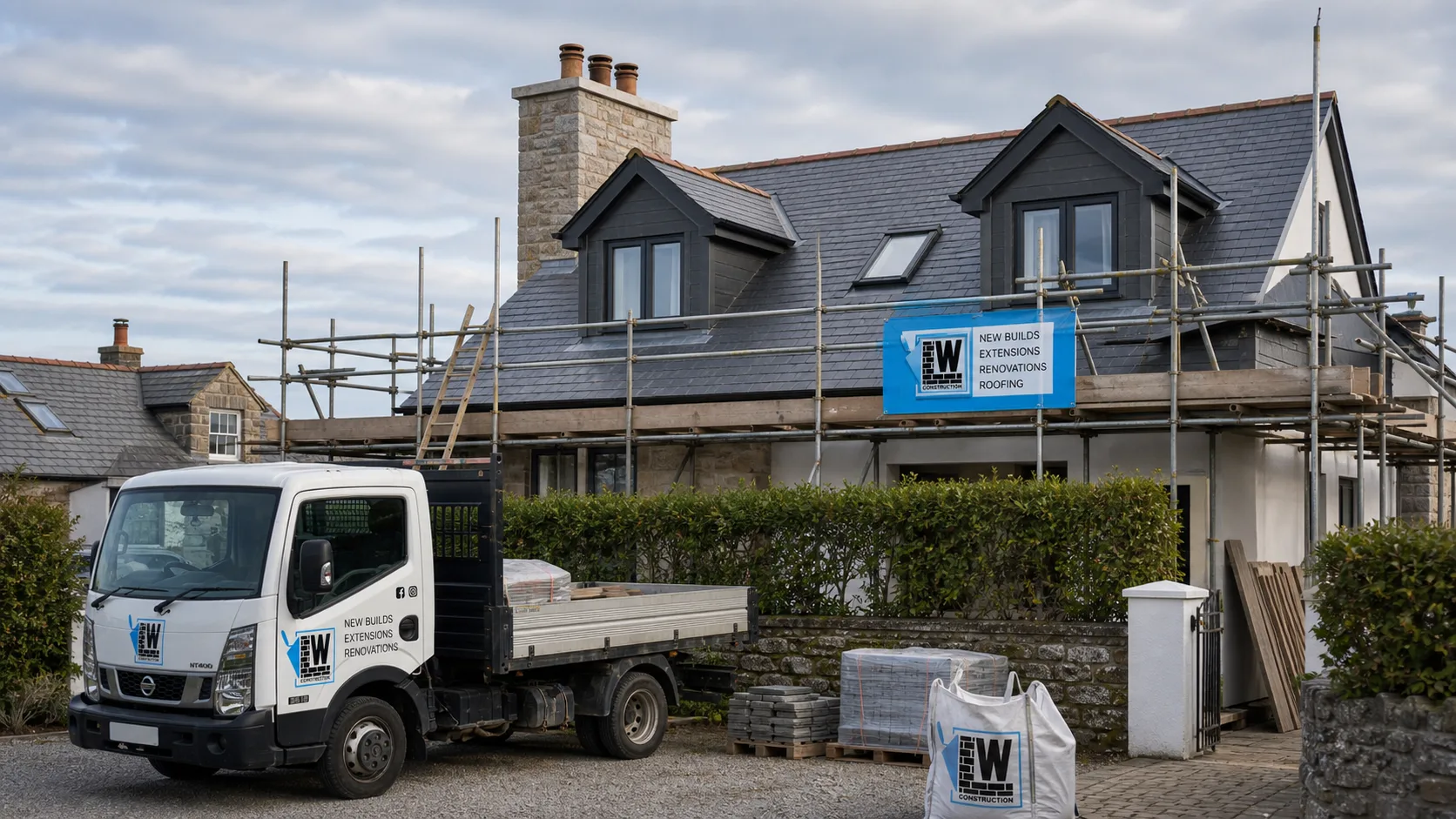
Roofing in Cornwall — What Matters
Roofing is the weather-tight covering on top of your house — the structural timbers, the insulation, the underlayment, the visible covering (slate, tile, or flat membrane), and the detailing at every junction (ridge, hip, valley, abutment, flashing). In Cornwall, every layer of that gets tested harder than inland — salt air corrodes fixings, the wind tries to lift coverings, and the rain finds every weakness.
A roof that's specified for inland England may not last in Cornwall. Slate and tile fixings need to be stainless or salt-rated. Flat roof membranes need UV and saline resistance. Ridge fixings, eaves details, and lead flashings all need consideration that mainstream roofing spec sometimes skips.
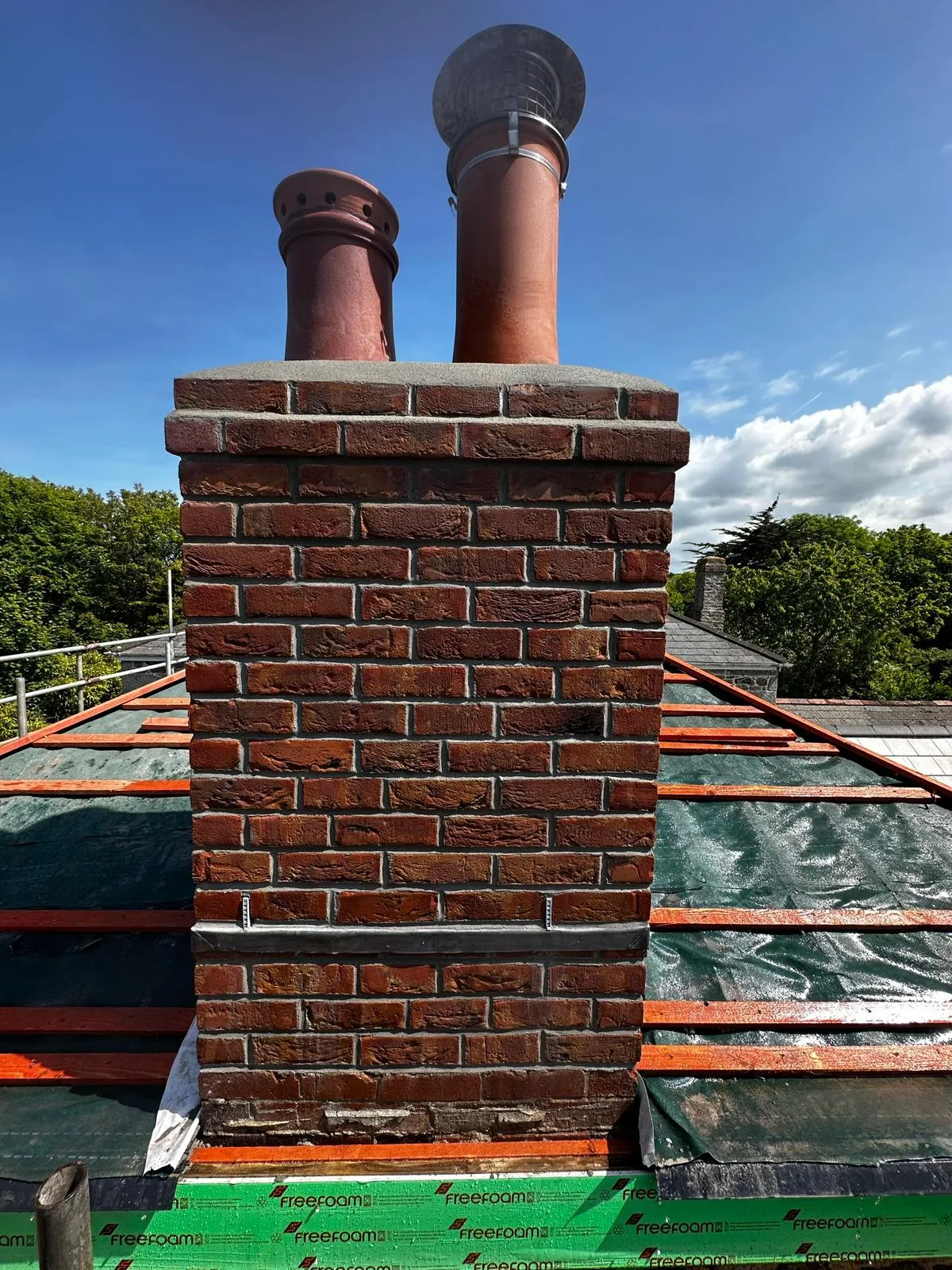
Types of Roofing We Work In
Slate roofing
natural slate (Cornish Delabole slate where available, Welsh slate as the common modern choice) or fibre-cement slate. Standard pitched-roof covering across most of Cornwall's older housing stock. 80-150 year lifespan when properly installed.
Tile roofing
clay or concrete tiles. Common on modern Cornwall new builds. 50-80 year lifespan. Pattern, profile, and colour matter to match neighbouring properties in conservation areas.
Flat roofing — EPDM rubber
single-ply rubber membrane in one piece for most domestic flat roofs. UV-resistant, low-maintenance, 25-30 year lifespan. Common on Cornwall extensions, dormers, and over-garage rooms.
Flat roofing — fibreglass (GRP)
multi-layer fibreglass with topcoat. Hard-wearing, walkable, 20-30 year lifespan. Good for balconies and where rooftop access is needed.
Bitumen / mineral felt
older flat roof type. We repair and replace these, but for new flat roofs we recommend EPDM or fibreglass for longer life.
Lead work
flashings, valleys, hip detailing, chimney aprons. Done correctly, lead lasts the life of the roof. Done poorly, it's the first leak point.
Benefits of Cornwall-Spec Roofing
Fixings that don't rust out by the sea.
Standard galvanised fixings corrode in Cornwall coastal air, so we use stainless steel slate hooks, nails, and screws on every coastal-exposed roof — the roof stays put for decades.
An underlay that lasts as long as the roof.
A modern breathable membrane rated for wind uplift and UV sits under every covering. Cheap building-merchant felt cracks in 5-10 years; the rated membranes we use last 30+.
No leaks at the edges where Cornwall roofs fail.
We detail eaves with proper drip edges, fix ridge tiles mechanically (not just bedded), and install lead aprons at every abutment — the places the wind finds.
No puddling on your flat roof.
Flat roofs need proper falls to drain. We fall the deck to the outlets so water actually runs off, rather than hoping the membrane sheds it.
You're covered if anything goes wrong.
A 12-month workmanship warranty on every roof we build or replace — if a fixing fails or a detail leaks within 12 months, we come back and fix it.
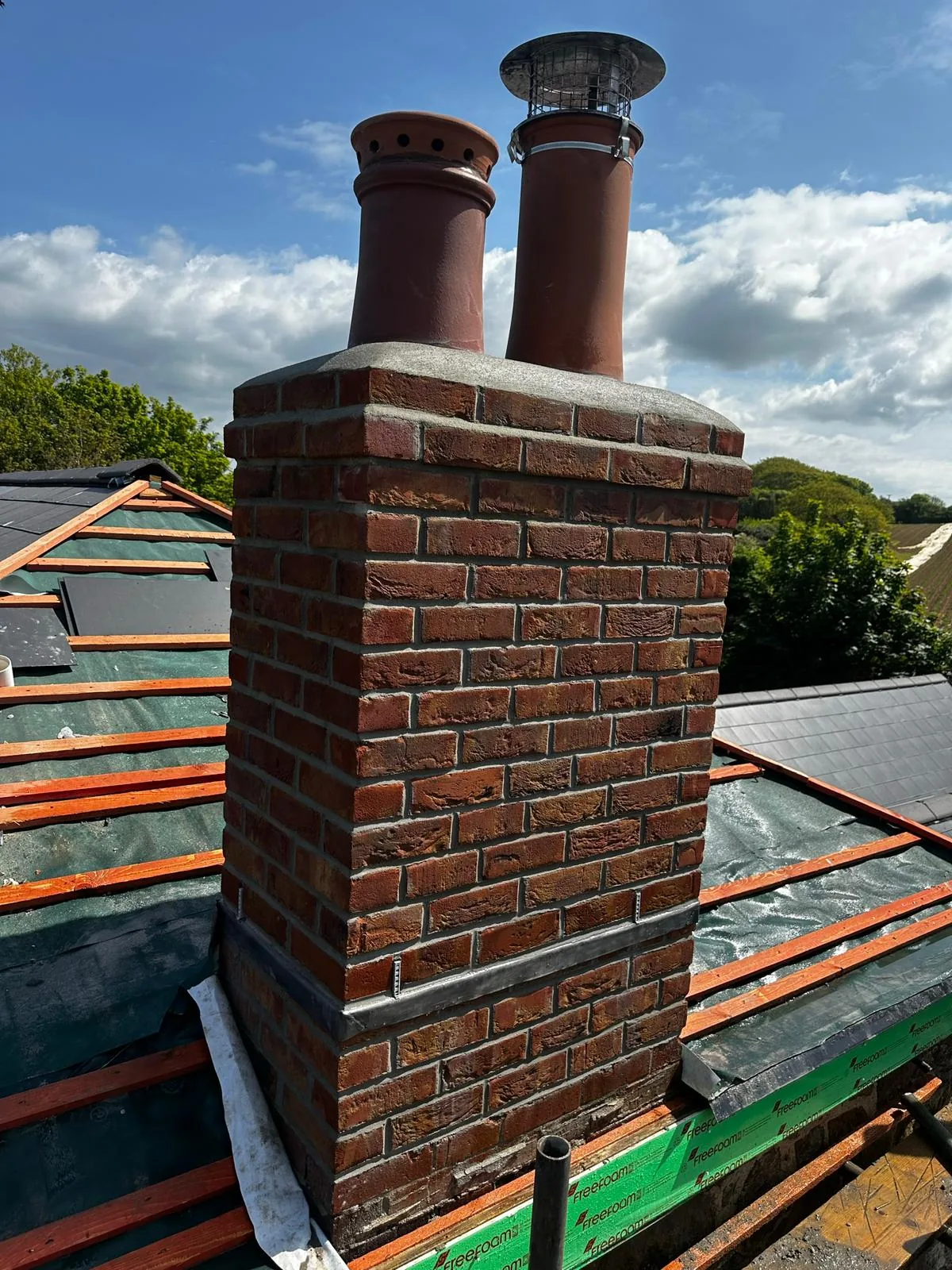
Roofline chimney rebuild — Before
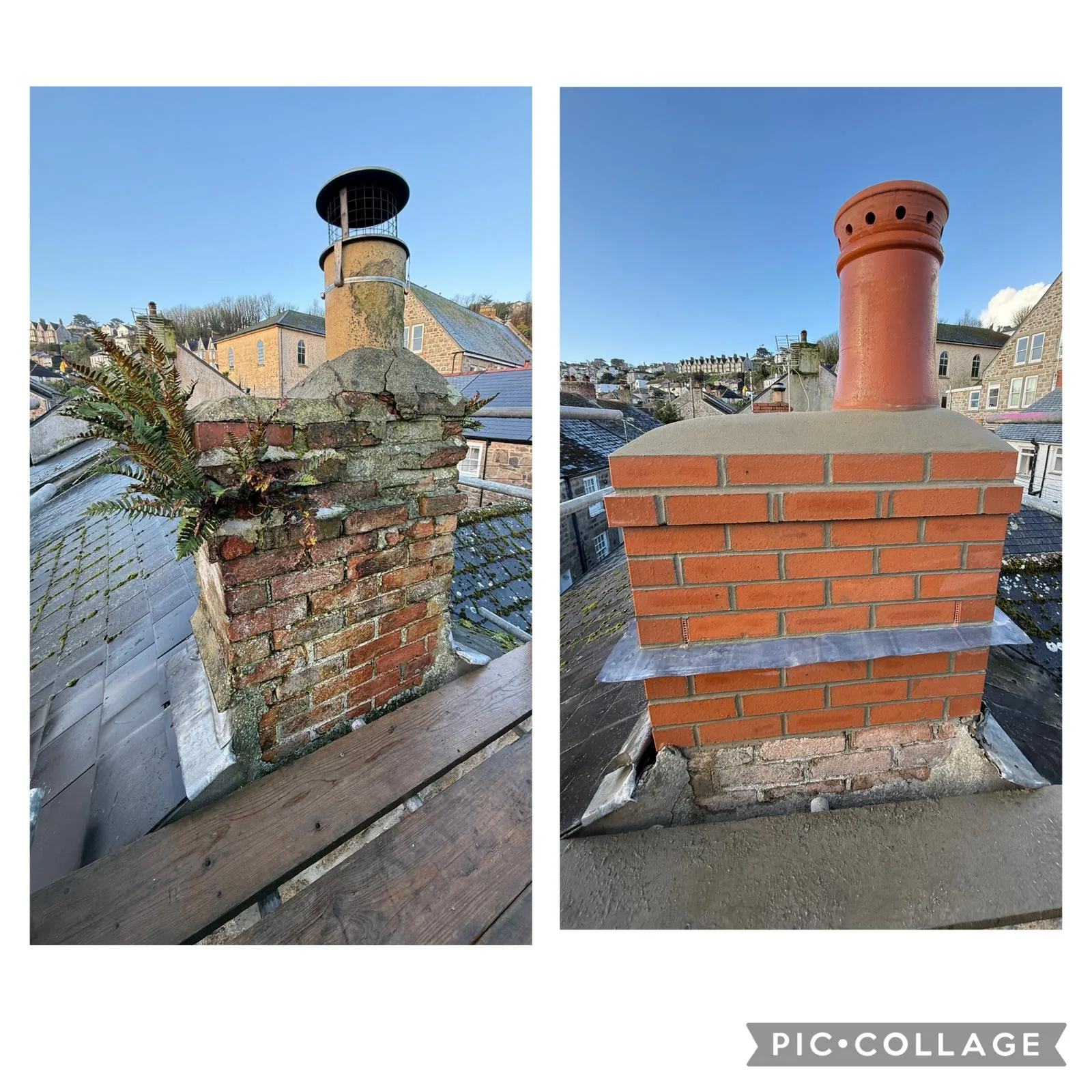
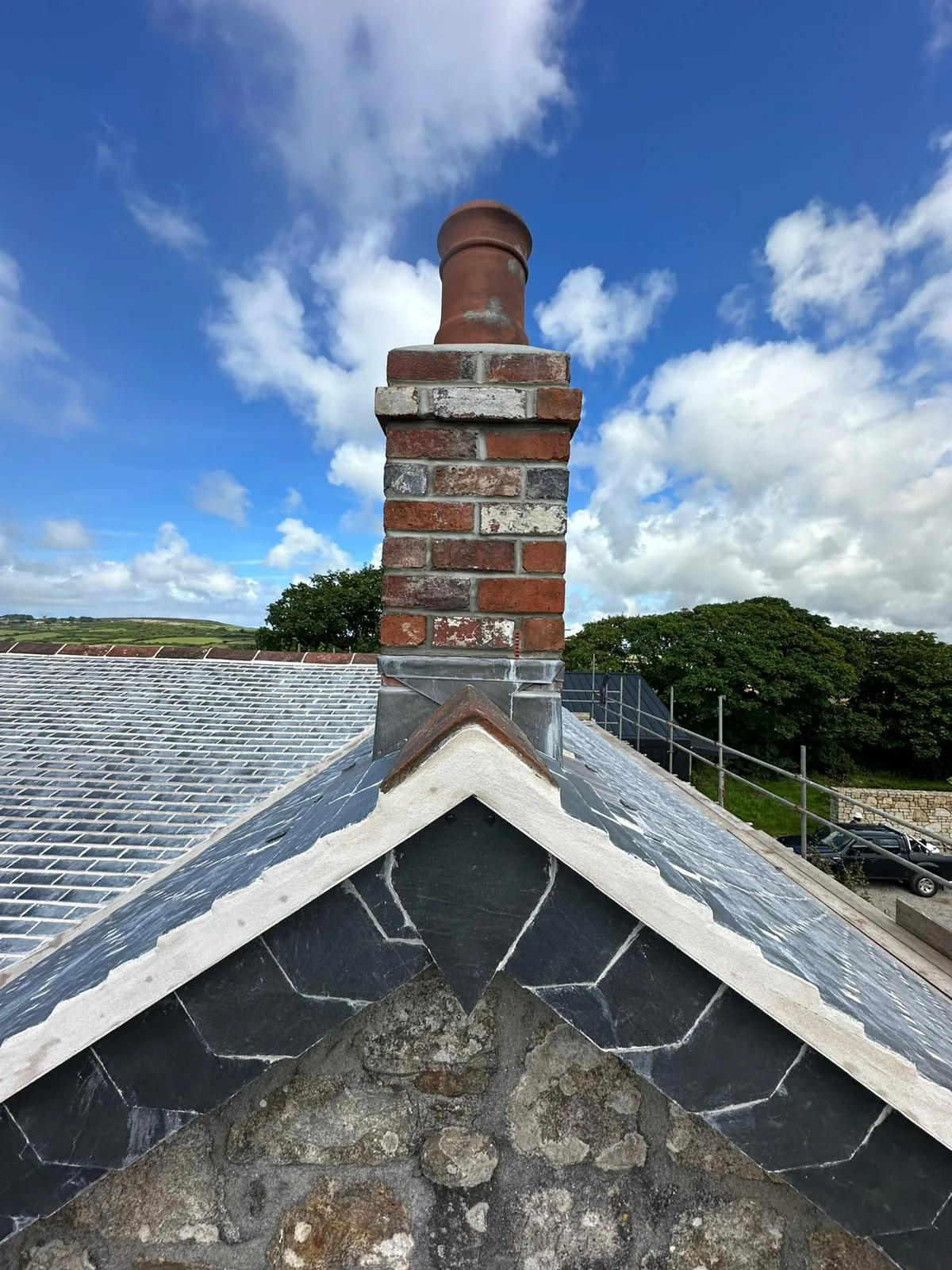
Roofline chimney rebuild — After
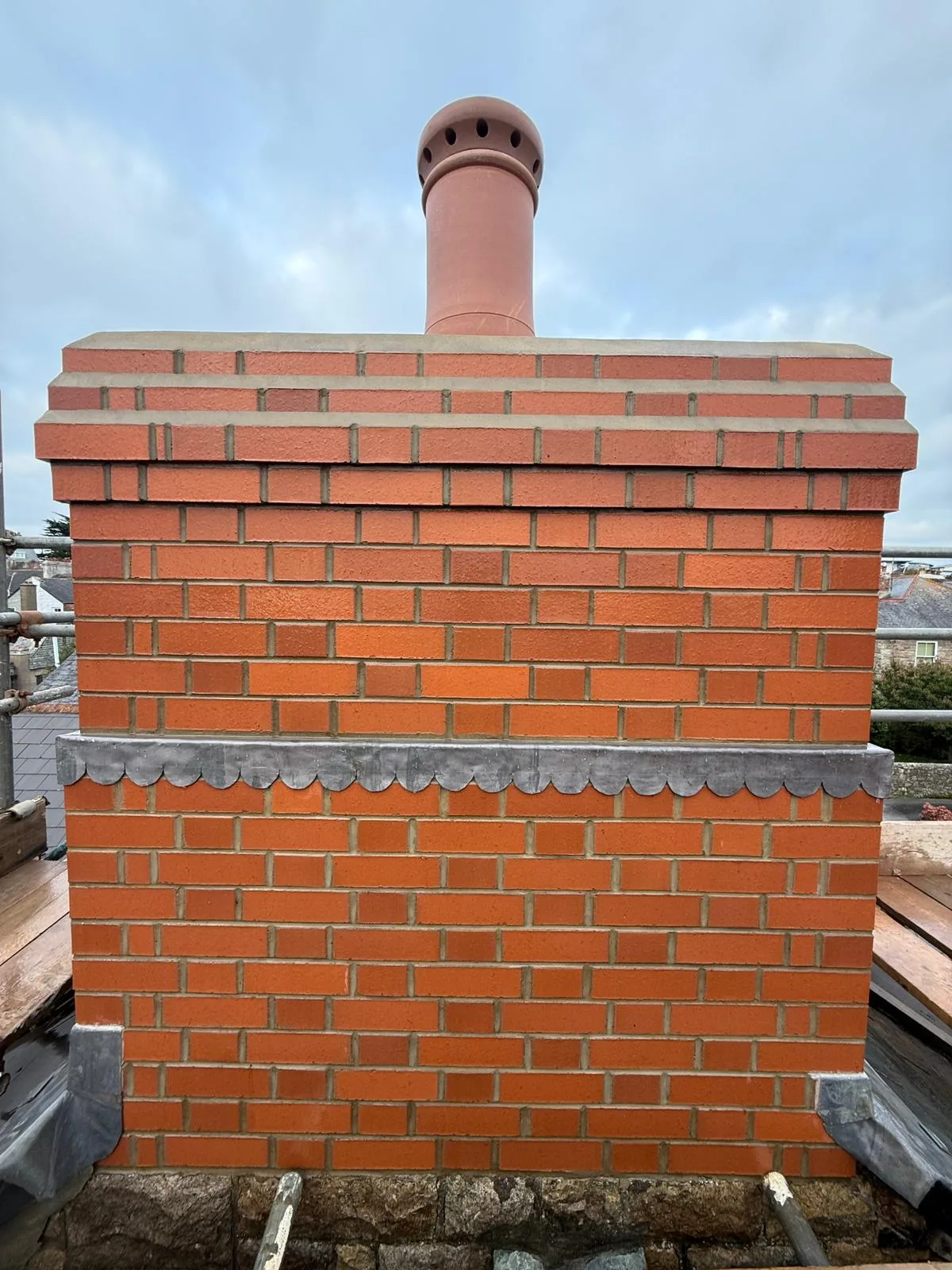
Our Roofing Process
Site visit + roof inspection. We climb the roof (or use a drone where access is restricted), inspect the existing covering, check for structural issues, photograph everything.
Quote in 48 hours. Itemised — strip-off, structural repairs (if any), underlay, covering, flashings, ridge, eaves, scaffolding.
Scaffold up. Full scaffold to all elevations. Edge protection per HSE Working at Height regulations.
Existing covering stripped. Old slates/tiles/membrane removed. Old timbers inspected; rotten or sub-standard timbers replaced.
Structural repairs. Any rafter, purlin, or wall plate replacement done at this stage. Insulation upgraded if specified.
Underlay laid. Breathable membrane to current spec, lapped correctly, fixed at battens.
Battens and counter-battens. Pressure-treated softwood. Stainless fixings.
Covering laid. Slates, tiles, or membrane installed to manufacturer's spec. Stainless fixings throughout on coastal exposure.
Flashings and detailing. Lead at chimneys, abutments, valleys. Ridge tiles bedded and mechanically fixed.
Scaffold down + clean-up. Site cleaned, old roof material removed and disposed of.
What's Included
- Scaffold supply and erection for the duration
- Strip-off of existing covering and disposal
- Inspection and replacement of rotten timbers
- Breathable underlay membrane
- Battens (pressure-treated)
- Slates, tiles, or flat membrane to specification
- Stainless steel fixings throughout on coastal sites
- Lead flashings to chimneys, abutments, valleys
- Ridge and hip detailing
- Gutters, fascias, soffits (where specified)
- Final clean-up
- 12-month workmanship warranty
Separately: structural engineering if substantial timber replacement, slates/tiles supplied to your spec.
What Drives the Cost of a Cornwall Roof
A roof repair is a low-cost job at the bottom of the scale; a flat roof on an extension is a mid-four-figure job; a full tile or slate re-roof on a house is a five-figure project. Rather than quote a number before we've been up on the roof, here's what moves the price:
- Covering — natural slate is the dearest, then clay or concrete tile, then EPDM and fibreglass flat-roof systems.
- Roof size and complexity — a simple gable roof is quicker than one with hips, valleys, and dormers.
- Structural condition — rotten timbers found on strip-off add to the job; sound timbers don't.
- Scaffold — height, access, and the number of elevations needing scaffold all affect cost.
- Coastal-spec fixings — stainless throughout on exposed coastal roofs, which costs more than standard galvanised but is non-negotiable here.
- Repair versus replacement — a localised leak repair is a fraction of a full re-roof.
Cornwall sits a little above the national average because of scaffold logistics and coastal-spec fixings. We give a clear, itemised fixed-price quote after a site visit, with a 12-month workmanship warranty.
Why Choose L W Construction for Cornwall Roofing
- A roofer who knows Cornwall weather. Over 20 years' experience on Cornwall coastal sites means we know which slates last on the Lizard, which tiles weather well inland, and which flat-roof membranes don't fail at year 5.
- Chimney and abutment work done in-house. NVQ Level 3 + Diploma Level 3 in Bricklaying — the masonry side of a roof is qualified-trade work, not sub-contracted out.
- You're protected on every job. £1 million public liability via Zurich Tradesman Insurance.
- You can check us before you commit. 5.0 stars from 22 Google reviews.
- Your roof is spec'd for the salt. According to BRE's 2024 climate-resilience report, salt-spray exposure on Cornwall coastal roofs requires fixings rated to BS EN 10088 (stainless steel grade 304 or 316). We spec stainless throughout on every coastal job — non-negotiable.
About the Builder
Luke Walker. NVQ + Diploma Level 3 Bricklayer.
"Cornwall roofs leak in the details — not in the middle of a slope. The eaves, the ridge, the chimney lead, the valley. If those are right, the rest of the roof can be average and it'll still hold up for 50 years."
— Luke Walker, Founder, L W Construction
Areas We Cover for Roofing
We re-roof, repair, and replace roofs across west and central Cornwall, working from our base in Heamoor, Penzance. We cover:
- Penzance — our home patch, including Heamoor, Newlyn, and the surrounding villages.
- Truro — slate and tile re-roofs across the city and outlying parishes.
- Newquay — wind- and salt-exposed coastal roofs on the north coast.
- Helston — the Lizard and Helston area.
- Falmouth — including Penryn.
- St Ives — exposed coastal roofs needing stainless-spec fixings.
- Camborne — Camborne, Pool, and Redruth corridor.
- Hayle — estuary-side properties and flat-roof extensions.
Wherever your roof is across Cornwall, call Luke on 07749 468160 for a free roof inspection.
Recent Roofing Work in Cornwall
We're adding more recent roofing projects to our portfolio as they complete — slate and tile re-roofs, flat-roof extensions, and chimney work from across Cornwall.
See our Cornwall project portfolio → for completed work across roofing, extensions, and new builds.
What Cornwall Homeowners Say
Related Services
- Loft Conversions — roof opening for dormer formation.
- House Extensions — roof to match the existing house on every extension build.
- New Builds — roof structure and covering as a stage of the new build.
- Plastering and Rendering — wall finishing alongside roof and gable work.
Need Cornwall roofing work?
Free roof inspection, written quote in 48 hours.
Last updated: Thursday 24th September 2026
Frequently Asked Questions
What roofing materials work best in Cornwall?
Slate (natural Delabole or Welsh) is the most traditional and longest-lasting — 80-150 years if installed correctly. Concrete and clay tiles run 50-80 years. For flat roofs, EPDM rubber gives 25-30 years and fibreglass (GRP) 20-30 years. Cornwall's coastal salt makes stainless fixings essential on every option.
Can you install a flat roof on an extension?
Yes. Flat roofs work well on single-storey extensions and dormers. We use EPDM rubber membrane (single-piece, low-maintenance, 25-30 year life) or fibreglass GRP (walkable, hard-wearing, 20-30 years). Both materials suit Cornwall flat-roof applications. Falls designed to 1:40-1:60 for proper drainage.
How long does a roof replacement take?
A typical 3-bed property full re-roof takes 5-10 days site time, weather depending. Flat roof replacements on a single-storey extension take 2-4 days. Cornwall weather can extend timelines — we don't lay roof in heavy rain or high winds.
Can you repair a leaking roof?
Yes. Most Cornwall roof leaks come from one of three places — slipped slates or tiles, failed lead flashing at chimneys or abutments, or compromised valley details. We diagnose the leak source first, then repair it specifically rather than guessing. A localised repair is a low-cost job compared with a full re-roof; we'll tell you straight whether a repair is enough or whether the roof is reaching the end of its life.
Will you replace gutters, fascias, and soffits?
Yes — gutters, uPVC fascias and soffits, and downpipes can all be replaced as part of a re-roof or as standalone work. Cornwall coastal weather hits uPVC harder than inland, so we use UV-stabilised fixings and recommend re-securing every 8-10 years.
Do I need planning permission or building control for roofing work?
A like-for-like re-roof in the same material usually doesn't need planning permission, though Building Regulations apply when you replace more than a quarter of the roof — mainly for insulation and structure. Changing the covering type, or roofing in a conservation area or on a listed building, can need consent. We tell you exactly what applies at the inspection and liaise with Cornwall Council Building Control where it's required.
What deposit or payment schedule do you work on?
For a roof we normally take a deposit to cover materials and scaffold at the start, then the balance on completion once you've checked the finished work. On larger re-roofs payments can be staged against progress (strip-off, structure, covering, completion). No large cash sum up front.